
The Urgency
AI is already in school.
The risk is having no plan.
A child entering kindergarten today graduates college in 2042. By then, AI will be deeply embedded in nearly every industry students enter. The tools, the expectations, and the nature of work itself will look materially different from today.
Yet most schools still optimize for skills AI already does well: memorizing facts, following procedures, standardized problem-solving. Students are being trained to compete with machines — and machines will always win that competition.
This pathway doesn’t chase the hype or avoid the question. It teaches the four capabilities that stay valuable regardless of which tools dominate next year: orchestrating AI systems, exercising human judgment, learning how to learn, and building real things.
- Shift from memorization to orchestration — students learn to direct AI, not compete with it
- Cultivate the human capabilities — creativity, ethics, leadership — that compound over a career
- Build metalearning habits so students can adapt as tools and industries evolve
- Replace worksheets with real projects, real employers, and real community impact

The Core Framework
Four skills that outlast every tool update
Schools that teach students about AI give them a semester of relevance. This pathway teaches them four capabilities that stay valuable regardless of which tools come next — starting from Day 1, in every course.
Not just using one chatbot — understanding how AI systems work and combining multiple tools to accomplish complex goals. Prompt engineering, output evaluation, multi-tool workflows. This is becoming a foundational literacy for school, work, and civic life.
Genuine creativity, emotional intelligence, ethical judgment, leadership. These aren’t “soft skills” — they’re the most durable human advantages in an AI-saturated economy. Every course cultivates them through community engagement, ethical reasoning, and collaborative problem-solving.
Facts change. Tools evolve. The only permanent skill is the ability to learn new things rapidly. Students practice metalearning throughout the pathway: approaching new domains, identifying what matters, evaluating their own understanding, and adapting as technology shifts.
Every course involves making things that didn’t exist before — not worksheets, not standardized tests. AI self-portraits, bias audit campaigns, community solution prototypes, professional portfolios, public capstone projects. The future belongs to builders.
Differentiation
Why this pathway instead of a generic AI curriculum
National vendors offer semester-long AI survey courses — useful introductions, but they stop at awareness. This pathway is built for institutional adoption: a multi-year program of study with credentials, internships, and local relevance that a one-semester product cannot provide.
- Teaches students about AI — awareness without application
- No progression from literacy to orchestration to professional practice
- Zero project-based learning, zero work-based learning hours
- Geography-agnostic — same content in Maine and Colorado
- Annual participation fees ($500–$2,200) plus $1,200 PD
- No credentials, no postsecondary articulation, no portfolio
- 3-course sequence built around AI orchestration, not just awareness
- Human-exclusive skills — creativity, ethics, leadership — in every course, not an elective add-on
- Metalearning practiced throughout: students learn how to learn new tools and domains
- Students build real things from Day 1 — portfolios, prototypes, public capstones
- 80+ hours of work-based learning with Colorado employers; industry certifications included
- Grounded in Colorado communities, industries, and regional strengths — structured for Perkins V planning, SBCCOE approval workflows, and CTA reimbursement
For Decision-Makers
Why administrators say yes to this model
This pathway is designed to reduce the biggest barriers that stop new programs from getting approved.
Designed to fit Colorado’s existing CTE funding and approval structure: Perkins V as supplemental support, CTA reimbursement for eligible approved-program costs, and phased local implementation rather than a new budget category.
Runs on existing devices with web-based tools and phased implementation. No new labs, no expensive licenses.
No coding prerequisite barriers. Designed for broad student participation across backgrounds and skill levels.
Connects AI to real Colorado industries, communities, and postsecondary pathways — from aerospace to clean energy.
Built with privacy, ethics, and teacher oversight in mind. Structured to support district compliance review from the start.
Creates student work, credentials, showcases, and partnerships that communities can actually see and celebrate.
“Colorado’s future workforce sits at the intersection of space, software, energy, health, and public problem-solving. This pathway is built for that reality — teaching students to use AI with judgment, creativity, and a strong sense of place.”The Summit and the Signal — Design Philosophy
Student Outcomes
What students walk away with
- AI orchestration fluency The ability to evaluate, combine, and direct multiple AI tools toward complex goals — not just chat with a bot, but orchestrate systems.
- A professional portfolio of things they built Curated artifacts from every course: bias audits, community prototypes, creative works, and a public capstone project addressing a real Colorado challenge.
- Human skills that compound Three years of practiced ethical reasoning, creative problem-solving, community engagement, and collaborative leadership — the hardest capabilities to automate and the most valuable to employers.
- The ability to learn what doesn’t exist yet Metalearning practice throughout the pathway: approaching unfamiliar domains, evaluating new tools, adapting as technology evolves.
- 80+ hours of real work experience Structured work-based learning with a Colorado employer or partner setting — from space and cyber to health systems, energy, public-sector data, or civic problem-solving. Plus stackable credentials and concurrent-enrollment college credit potential.
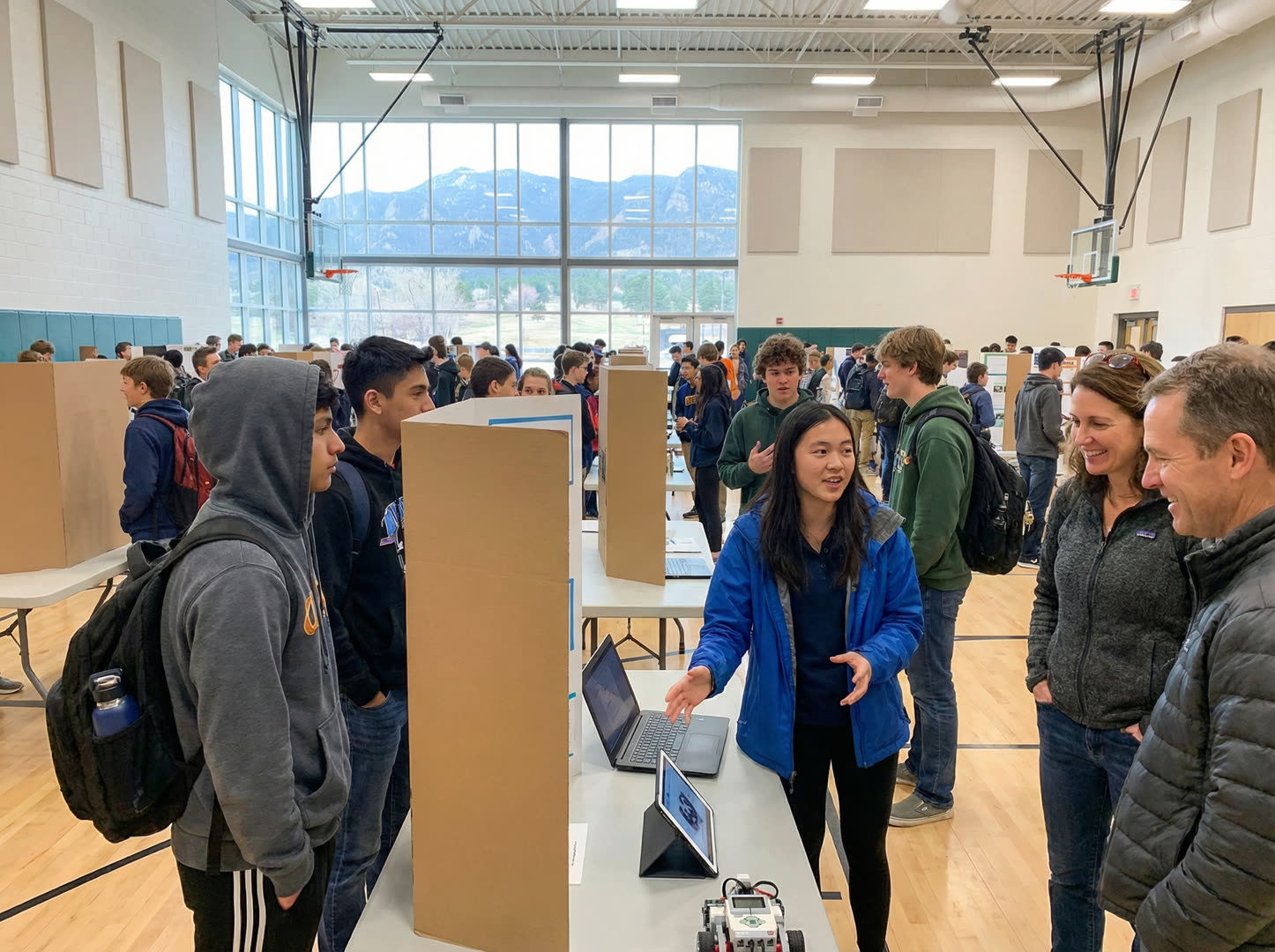
Lowest-Risk Entry Point
Start with a summer workshop
Not ready to launch a full pathway? Start with the 5-day summer workshop. It introduces the same four pillars in compressed form: students learn how AI works, practice judgment and creativity, adapt quickly across unfamiliar tools, and build public-facing work — all in one week. It gives schools a visible, community-friendly way to test demand, recruit students, and demonstrate what AI education actually looks like.
Demystify AI through hands-on stations. Train classifiers, interrogate chatbots, create AI self-portraits of future Colorado.
Train classifiers with local data, run bias labs on image generators, encounter deepfakes. Build a “Fix the Bias” campaign.
Visual storytelling, narrative co-writing, AI music. Create “Postcards from Future Colorado” and a collaborative digital mural.
Case studies on wildfire, water, clean energy, healthcare, space. Guest speaker from Colorado tech/research. Launch culminating projects.
Finalize “AI for Good in Colorado” projects. Public showcase for families, college faculty, industry partners. Pathway enrollment info.
- Low-risk pilot before full implementation
- Student recruitment tool for the full pathway
- Family and community engagement moment
- Early proof point for district and state stakeholders
- Professional development for staff
- Functions as a smart first step, not a side event
The Program of Study
A practical way to launch AI education in high school
This is not a full computer science rebuild. It is a 3-course CTE pathway where the same four pillars deepen over time: Course 1 builds literacy and confidence, Course 2 develops orchestration and ethical judgment, and Course 3 applies all four in real workplaces and public-facing projects. Schools can adopt in phases.
-
Unit 1 — Weeks 1–3
What Is AI?
Defining AI, brief history, AI in daily life, the hype cycle. Unplugged sorting games and Turing tests. “AI Audit” of students’ own tech use.
-
Unit 2 — Weeks 4–6
How AI Sees the World — Perception
Sensors, computer vision, speech recognition, NLP basics. Train image/sound classifiers with Teachable Machine. Colorado connection: satellite imagery and wildfire detection.
-
Unit 3 — Weeks 7–9
How AI Thinks — Representation & Reasoning
Data foundations, decision trees, knowledge graphs, recommendation systems, intro to neural networks. Colorado connection: NIST measurement and standards systems.
-
Unit 4 — Weeks 10–12
How AI Learns — Machine Learning
Supervised/unsupervised/reinforcement learning, generative AI basics, training data supply chain. Colorado connection: NREL energy modeling and climate data.
-
Unit 5 — Weeks 13–15
AI, Bias & Society
Algorithmic bias, data sovereignty, surveillance and privacy, environmental cost of AI, regulation. Bias Audit project and Community Perspectives Panel. Colorado connection: SB24-205 consumer AI protections (implementation delayed to June 2026 by SB25B-004), algorithmic transparency debates.
-
Unit 6 — Weeks 16–18
AI Futures — My Voice, My Community
AI workforce landscape, Colorado AI careers across aerospace, defense, health, and energy. Capstone communication project for a public audience. Portfolio assembly and pathway planning.
Tools: Google Teachable Machine, ChatGPT Education, Hugging Face Spaces, TensorFlow Playground, Canva, Google Sites
Standards alignment: Colorado Academic Standards for Computer Science (2024 revision) — Computational Thinking, AI, Digital Citizenship; Colorado CTE IT Pathway standards; supports ICAP/PWR career development integration
-
Unit 1 — Weeks 1–3
Power User — Advanced AI Interaction
Prompt engineering, multi-modal AI, output evaluation, academic integrity. Compare ChatGPT, Gemini, Claude, and open-source models.
-
Unit 2 — Weeks 4–6
Ethics Lab — Frameworks for Hard Questions
Consequentialism, deontology, virtue ethics, care ethics, community-based ethics. FATE framework. Deep case studies including Colorado-specific AI dilemmas in defense, healthcare, and climate.
-
Unit 3 — Weeks 7–10
AI Across Domains — Applied Intelligence
Healthcare, environment, creative arts, journalism, education, government, business. Domain deep dives with Colorado industry connections across aerospace, energy, cyber, and bioscience.
-
Unit 4 — Weeks 11–15
Design Thinking + AI — Community Solutions
5-week PBL: identify a real Colorado community problem, conduct empathy interviews, design an AI-informed solution, present to community panel.
-
Unit 5 — Weeks 16–18
Portfolio & Professional Readiness
Digital portfolio curation, resume writing, mock professional interviews, internship preparation. Microsoft AI-900 certification alignment.
Additional tools: Perplexity AI, Runway ML, Suno AI, NotebookLM, Figma, Miro, Kialo, Google Colab
Standards alignment: Colorado Academic Standards for CS — Programming, Cybersecurity, Systems & Networking; IT CTE Pathway standards
-
Unit 1 — Weeks 1–3
Professional Launch
Workplace expectations, internship orientation, professional communication, workplace AI audit, capstone topic exploration and proposal.
-
Unit 2 — Weeks 4–12
Internship Immersion + Capstone Development
Minimum 80 hours on-site/remote/hybrid. Weekly classroom seminar for reflection, capstone workshops, guest speakers, advanced AI topics. Supervisor evaluations at weeks 6 and 12.
-
Unit 3 — Weeks 13–18
Capstone Completion & Public Showcase
Intensive capstone production, peer review, comprehensive portfolio assembly, public presentation to industry partners, college faculty, families, and community. Pathway exit interview.
Credentials earned: AI Capstone Micro-Credential, AI Literacy Professional Certificate, Microsoft AI-900, CompTIA ITF+

Program at a glance
Implementation
What it takes to launch
School leaders need to know whether a new program is realistic. This one is built to be. Schools can start with a workshop, a single-course pilot, or a phased multi-year rollout.
- 1 lead CTE instructor with AI literacy professional development and appropriate Colorado CTE credentialing
- Existing Chromebooks or laptops — all tools are browser-based
- Teacher-managed AI tools with documented parental consent process
- Pathway or pilot timeline — start with workshop, Course 1, or full sequence
- Local advisory development with industry and postsecondary partners over time
Recommended timeline
- Spring 2026 Finalize curriculum, begin Colorado CTE Gateway program approval and instructor credentialing process, recruit employer partners
- Summer 2026 Launch AI Futures: Colorado summer workshop at a Front Range campus
- Fall 2026 Launch Course 1 pilot with first cohort (25–30 students)
- Spring 2027 Launch Course 2; refine Course 1 based on pilot data
- Fall 2027 Launch Course 3 capstone/internship; first full-pathway cohort
- 2028–29 Full operation, first graduates, replication package for other Colorado districts
Funding Fit
How schools can fund it
This pathway is built to align with the structures schools already use to launch and sustain CTE programs. It does not require new funding streams.
- CTA reimbursement for SBCCOE-approved CTE program costs — Colorado’s primary state mechanism for funding secondary CTE
- Perkins V for program development, PD, devices, certifications, and WBL coordination — aligned to regional needs assessment
- Concurrent enrollment support through local college partnerships, often with CCCS colleges, with tuition commonly covered through district/state mechanisms
- Innovation grants such as CCCS Innovations in CTE Grants and Opportunity Now workforce funding
1S1 Graduation Rate • 2S1 Academic Proficiency • 3S1 CTE Concentrator Proficiency • 4S1 Non-Traditional Participation • 5S1 Program Completion • 5S2 Postsecondary Placement
CTA alignment: Designed to align with SBCCOE program approval through the Colorado CTE Gateway, instructor credentialing requirements, and eligible cost reimbursement under CRS 23-8-101. CTA rules are being updated in 2026 — an active policy window for new pathway modernization.
Regional needs assessment fit: Colorado’s biennial CLNA process emphasizes regional workforce alignment. This pathway maps to high-demand AI-adjacent roles in aerospace, cyber, health, energy, and software — sectors present across multiple Front Range regions.
Funding references describe alignment and fit, not guaranteed funding. Consult your district CTE coordinator and CCCS regional contact for specific CTA and Perkins eligibility.
Institutional Proof
Built for credibility from day one
This pathway is not a concept — it is a fully designed program of study aligned to Colorado’s existing IT and interdisciplinary pathway structures, state standards, and industry ecosystem.
Common Questions
What decision-makers ask first
No. The model is built around literacy, ethics, and practical career relevance — not trend-chasing. It gives schools a structured response to technology students are already using. The curriculum is grounded in established frameworks (AI4K12, ISTE, UNESCO) and designed for long-term CTE viability, not a one-year experiment.
No. This pathway is designed for CTE adoption, not a full CS rebuild. It is most naturally housed within Colorado’s Information Technology pathway area or a related approved pathway, depending on district design. It requires one CTE instructor with AI literacy professional development. No coding prerequisite is required — the pathway emphasizes AI literacy, judgment, and creation first.
No. The entry point is open-access and built for broad participation. Course 1 requires zero prerequisites beyond basic digital literacy. Students who can use a web browser and create documents are ready to begin.
Yes. The entire tool stack is browser-based and Chromebook-compatible. Google Teachable Machine, ChatGPT Education, Canva, Google Workspace — all free or low-cost, all running in a browser. No specialized hardware, no new lab setups.
The model is structured around teacher-managed accounts, documented parental consent processes, content filtering, and a maintained tool compliance matrix. AI interactions are designed to flow through education-licensed accounts under teacher oversight, with no student PII entering AI tools. Structured to support district privacy and compliance review processes.
Start with the 5-day summer workshop or a Course 1 pilot. The model is intentionally phased. Many schools will begin with the workshop as a recruitment and proof-of-concept event, then add Course 1, then build the full pathway over 2–3 years as demand and capacity grow.
Because tool-specific training expires quickly. The durable value is not memorizing one platform’s interface, but learning how to evaluate tools, direct them well, exercise judgment where automation falls short, keep learning as systems change, and build work that matters in the real world. Those four capacities stay useful even as specific products come and go.
Every course engages all four pillars at increasing depth. Course 1 introduces AI orchestration (basic tool use), human-exclusive capabilities (bias discussions, community panels), metalearning (approaching unfamiliar tools), and building (AI self-portraits, audit campaigns). Course 2 deepens orchestration (multi-tool workflows), ethics (formal frameworks), learning agility (domain deep dives), and creation (community solution prototypes). Course 3 integrates all four in a professional setting: orchestrating AI in a real workplace, exercising judgment under professional conditions, learning an unfamiliar industry domain, and producing an original capstone.
The Career and Technical Act (CTA) reimburses districts for eligible costs of operating SBCCOE-approved CTE programs. Reimbursement is based on instructional costs, operating expenses, and student FTE from the previous year’s financial report. CTA does not automatically fund new or experimental offerings — the pathway must be housed within an approved program structure with proper Gateway approval and instructor credentialing. This pathway is designed to fit within that approval and reimbursement structure. CTA is currently funded at approximately $31 million annually, and districts submit more than $130 million in secondary CTE costs. Consult your district CTE coordinator and CCCS regional contact for specific eligibility details.
Explore whether this pathway fits your school, district, or region.
Start with a planning call, a workshop, or a pilot-year conversation. We’ll walk through whether this four-pillar model fits your students, your staffing reality, and your CTE goals — then map the most practical launch path.
Ideal for principals, district CTE leaders, concurrent enrollment coordinators, and state stakeholders evaluating future-ready CTE options for Colorado students.
Questions? Reach us at [email protected]